Design of A Mythical Africana Computer, or Keo : A People's Webputer, or Care considered Essential, or Culture over Compute
Introduction
Keo is an art project that draws inspiration from media archaeology and media computation. We focus our archaeological lenses on uncovering forgotten, obsolete, and often dismissed technologies and technical practices with particular attention given to their capacity to reveal knowledge production practices — including social, political and cultural realities — of previous eras. Using both archival and computational methods, we examine how computational media embeds and manifests cultural values, worldviews and belief systems.
Our goal in designing a mythical Africana computer is realizing a computational medium that blends fantasy as its primary means of socio-cultural expression, interaction, and knowledge production. By designing from an Africana perspective, we explore new possibilities for computation that are grounded in Africana philosophical traditions, oral histories, spiritual practices, and artistic expressions.
"People who are really serious about software should make their own hardware" – Alan Kay
In the same spirit as our primers before, we recognize that no virtual media is complete without its corresponding physical media and therefore plan on designing new interfaces and input devices that evoke joy and new computational architectures that can support these experiences.
Reflections on Worldbuilding
"You got to make your own worlds and write yourself in" – Octavia Butler
Our speculative mythical world builds on the tarot's abstract symbolic language as a highly adaptable multifaceted tool for creative storytelling, navigating growing complexity and capturing interdependence between different systems and domains. Through this symbolic language we layer meaning into our design to reflect diverse forms of knowledge production from various African cultures and traditions.
While reflecting on the critical role that myths and cultural practices play by providing the material basis that constitute our mythical world; bridging between different forms of knowledge, facilitating understanding across disciplines, and weaving together technical and poetic language to create new meaning-making frameworks.
Unfortunately for most Africana communities, efforts towards preservation and circulation of cultural memory remain constrained by an overreliance on external technologies and platforms controlled by entities far removed from these communities. By designing our own computational systems, we create space for autonomy, self-determination, and the authentic expression of our cultural values.
Designing for Play
"We think with the objects we love; we love the objects we think with." - Sherry Turkle
We re-imagine the analogical influences of earlier computing systems centered around desks top and office routines such as typing, inbox trays, forms, printing and filing; systems that are often utilitarian and limiting in their scope. Instead, we draw inspiration from interfaces designed for joy, creativity, and exploration.
We add a complementary compute layer our myth based social layer that draws inspiration from video games and other forms of interactive storytelling that center individual agency, narrative choice, and collaborative world-building. These systems encourage exploration, play, and creative expression within rich, immersive environments — following in the same light as our primers, as seen manifest in the Lively kernel and the Croquet WebOS architectures.
We design with resilience, autonomy and safety in mind building on DWeb standards like Content Identifiers (CIDs) for distributed file sharing and archival, InterPlanetary Naming System (IPNS) for decentralized top level domains, and Decentralized Identifiers (DIDs) for managing identities, wallets, civic engagement etc. We leverage seasoned web technologies like WebAssembly for computing at native speeds, and WebAPIs such as WebRTC for peer to peer communication, WebGPU for accelerated graphics processing, and Web Serial for extended I/O; bridging between the virtual and physical world and designing location based experiences.
We cultivate agentic creative expression by building accessible and malleable end-user interfaces that combine touch inputs, pen support, drag and drop, scripting etc. to stimulate creativity and discovery through remixing echoing earlier systems like Scratch and Etoys.
Our playful design converges as a complete, unified in-browser experience that we hope to materialize as a fun physical object that evokes joy and invites curiosity in a similar effort as the XO laptop.
Inspired by
Further Reading
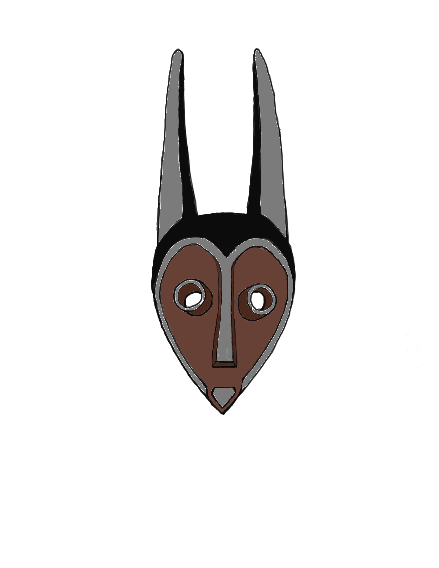
The Keo mascot is an adaptation of a Mbambi mask made by a Pende artist obtained from the MIA
- Africa and Byzantium Africa and Byzantium - Edited by Andrea Myers Achi (2023)
- Sahel: Art and Empires on the Shores of the Sahara Sahel: Art and Empires on the Shores of the Sahara - LaGamma (2020)
- Divine Egypt Divine Egypt - Edited by Diana Craig Patch and Brendan Hainline (2025)
- Black to the Future Black to the Future - The Power of Designing Afrofuturist Technology with Black Women, Femmes, and Non-Binary People - Klassen et al. (2024)
- Media Computation in Python Media Computation in Python running in Google Colab Notebooks - Guzdial (2025)
- Agential Realism and Education This is Not a Photograph of Zuko': how agential realism disrupts child-centred notions of agency in digital play research - Murris (2022)
- A World of Active Objects A World of Active Objects for Work and Play; The First Years of Lively - Ingall et al. (2016)
- Croquet Greenlight An Experiment in Live Collaborative Programming on the Croquet Shared Experience Platform - Yoshiki et al. (2022)
- Croquet Microverse Live Programming and Text Editor Integration in the Croquet Microverse 3D Collaborative Construction System - Yoshiki et al. (2022)
- Syndicated Actors Conversational Concurrency - Garnock-Jones (2017)
- Local First software Local First software - Kleppmann et al. (2019)
- Other Networks: A Radical Technology Sourcebook Other Networks: A Radical Technology Sourcebook - Emerson (2025)
- The history of LOGO History of LOGO - Cynthia et al. (2020)
- Kill Math Kill Math - Bret (2011)
- Smalltalk Zoo Smalltalk Zoo - Curated by Dan Ingalls (2020)
- The Dream Machine The Dream Machine, 4th Edition - Waldrop (2018)
- Design of LISP-Based Processors Design of LISP-Based Processors, or SCHEME: A Dielectric LISP, or Finite Memories Considered Harmful, or LAMBDA The Ultimate Opcode - Guy Steel Jr. & Gerald Sussman (1978)
Say hello
Send us an email.